Education · April 27, 2024
From Reflection to Reform: How a Train-the-Trainer Workshop is Challenging Bias
A bold new initiative is reshaping the way educators teach in Nigeria, moving towards more inclusive teaching methods.

Carol Barlow
CEO CEBAR Consultancy · 5 min read
As education systems around the world seek more inclusive and student-centred approaches to teaching, the need for pedagogical reform has never been more urgent. In Nigeria, where traditional, lecture-based teaching methods still dominate in many classrooms, a bold new initiative is beginning to reshape the way educators teach—and the way they think.
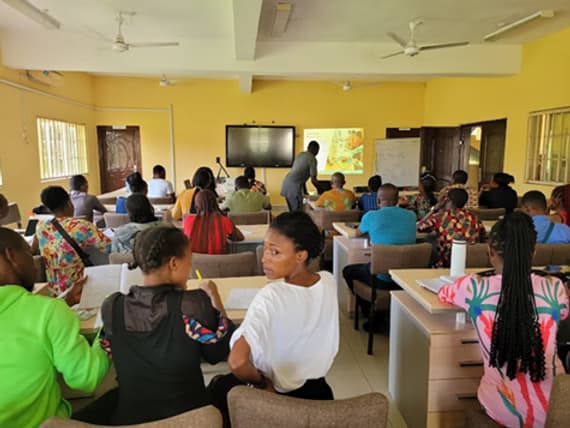
Earlier this year, the Sydani Group in partnership with CEBAR Consultancy and Training Services, hosted a five-day Train-the-Trainer workshop in Abuja. The purpose was clear: equip teacher educators from six Colleges of Education with the tools, strategies and reflective capacity to implement the 4-in-1 pedagogical model—a synthesis of Jigsaw collaborative learning, Problem-Based Learning (PBL), TPACK (Technology, Pedagogy and Content Knowledge), and Micro-Teaching.
But beyond the scheduled sessions and structured assignments, what emerged most powerfully from the workshop was something less tangible but arguably more transformative: critical self-reflection.
Bias, Inclusion and the Power of Honest Reflection
One of the most impactful moments of the workshop came not from a facilitator, but from a participant. A lecturer from Northern Nigeria shared:
“This course has made me truly reflect on my own biases with regards to gender and ability. I must be honest, on reflection, I tend to focus on the male students, and those who are the brightest. I need to do better.”
In a cultural and educational context where such admissions are rare—and sometimes even discouraged—this moment became a catalyst for wider discussion on gender equity and inclusive teaching. As UNESCO notes, “gender equality in education is not just a goal in itself, but a precondition for achieving all other education and development goals” (UNESCO, 2020). Yet, unconscious bias continues to limit learning opportunities for many students—particularly girls and students with lower perceived ability.
By encouraging educators to identify and confront their own biases, the workshop made visible the often-invisible dynamics that shape classroom practice. Research supports the importance of this kind of reflective practice: “Teachers’ expectations have a powerful impact on student achievement, and these expectations are often unconsciously influenced by gender, socio-economic background, and prior achievement” (Rosenthal & Jacobson, 1968).
Technology Integration: From Theory to Practice
Another key revelation during the workshop was the gap between awareness and practical application of technology in teaching. One participant reflected:
“My takeaway is how weak my technology skills are – I tend to rely on my technical assistant - and how I need to make much more effort to integrate collaborative teaching into my lectures.”
This kind of realisation is critical in a country where access to digital tools is growing, but digital literacy among educators remains low. According to the World Bank (2022), while Nigeria has made strides in digital access, “teachers often lack both the confidence and competence to integrate technology effectively in the classroom.”
However, progress was swift. That same participant later reported having implemented the Jigsaw Method in his own classes—with transformational results. Students were reportedly more engaged, more collaborative, and more enthusiastic. This supports the findings of Johnson & Johnson (1999), who found that “students in cooperative learning settings perform better academically, demonstrate greater motivation, and develop stronger interpersonal relationships.”
The Promise of the 4-in-1 Model
The 4-in-1 model introduced during the workshop is not merely a theoretical framework. It is designed to be practical, flexible, and responsive to the challenges of Nigeria’s teacher training landscape. By combining learner-centred strategies with reflective teaching and digital tools, the model offers an integrated pathway to more effective teaching.
Crucially, it addresses two persistent problems in Nigerian education: the dominance of lecture-style delivery and the underdevelopment of 21st-century skills such as collaboration, problem-solving and digital literacy.
What makes this approach especially powerful is its emphasis on modelling—participants didn’t just learn about the 4-in-1 strategies; they experienced them, practised them, and received feedback on their own implementation. This echoes Kolb’s Experiential Learning Theory (1984), which emphasises that “learning is the process whereby knowledge is created through the transformation of experience.”
Conclusion: Towards a Culture of Reflective Practice
The Train-the-Trainer workshop did more than just train facilitators. It sparked honest conversations, challenged long-held assumptions, and ignited a commitment to doing better—for all students.
As Nigeria strives to improve the quality and equity of its education system, this kind of reflective, evidence-based professional development must become the norm rather than the exception. The 4-in-1 model offers a powerful vehicle for this transformation.
But perhaps the most significant outcome of the workshop is a shift in mindset—from transmission to transformation, from certainty to curiosity, and from teaching to truly reaching every learner.
“We do not learn from experience... we learn from reflecting on experience.”
References
• Johnson, D. W., & Johnson, R. T. (1999). Learning Together and Alone: Cooperative, Competitive, and Individualistic Learning. Allyn & Bacon. • Kolb, D. A. (1984). Experiential Learning: Experience as the Source of Learning and Development. Prentice-Hall. • Rosenthal, R., & Jacobson, L. (1968). Pygmalion in the Classroom: Teacher Expectation and Pupils’ Intellectual Development. Holt, Rinehart & Winston. • UNESCO (2020). Global Education Monitoring Report: Inclusion and Education – All Means All. • World Bank (2022). Improving the Quality of Teaching and Learning in Africa.
- Training
- Reform
- Nigeria
- Inclusion
Written by
Carol Barlow
CEO CEBAR Consultancy